
Construction
Japan's building sites are short of people, and its construction workforce is ageing faster than it can be replaced. This programme prepares you for the Specified Skilled Worker (Construction) tests — and for the site Japanese and safety culture that decide whether you last once you are there.
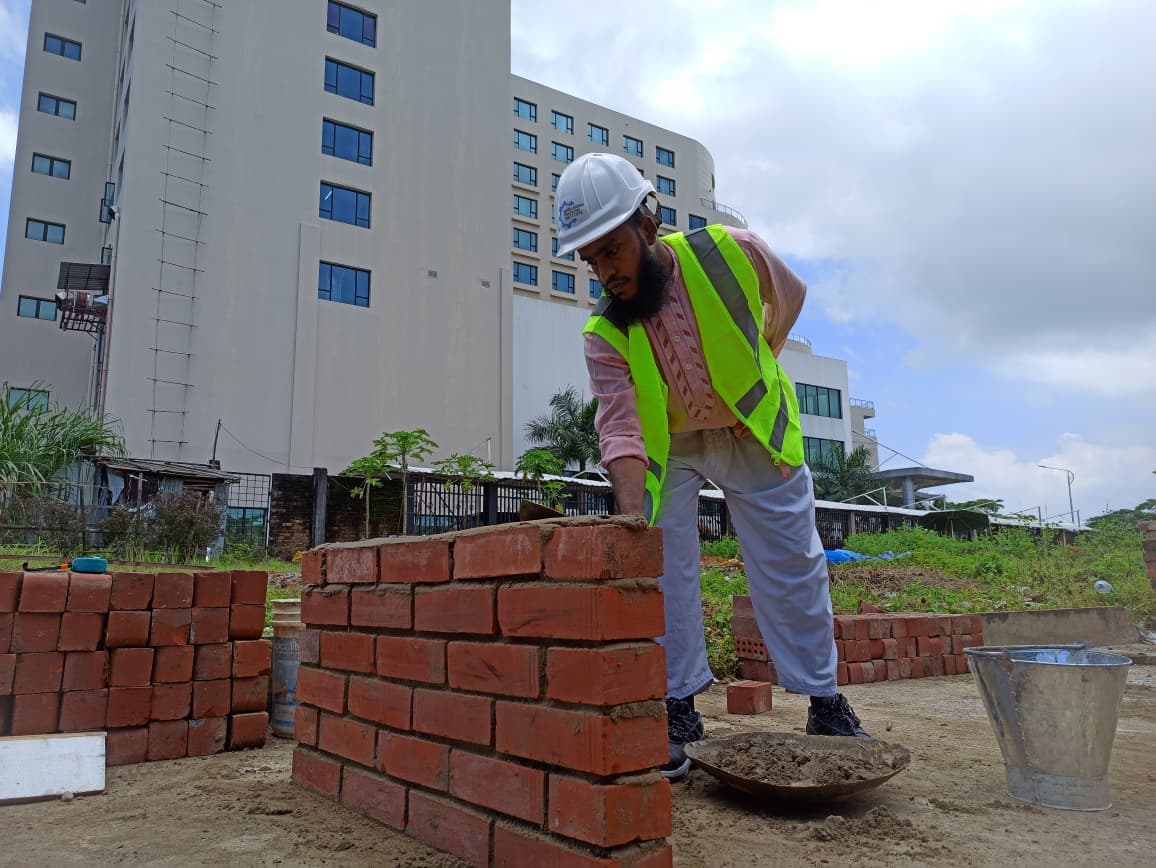
Who this is for
For people ready to work hard and learn a new language.
Age 18 or over. No educational requirement.
Physically fit for site work.
Ready to study Japanese every single day. This is the part that decides who succeeds.
What you learn
The trade, the language and the safety — together.
Site Japanese
The morning briefing, safety instructions, hazard-prediction (KY) activity, the names of tools and materials, and how to report, contact and consult (報連相). Japanese for the site, not just for the test.
Formwork and reinforcing bar
Setting up formwork and fixing rebar to Japanese practice — two of the trades Japanese sites need most.
Plastering and tiling
Surface preparation, plastering and tiling, to the finish and tolerance Japanese work expects.
Safety, every day
The equivalent of Japanese new-worker site induction, pointing-and-calling (指差呼称), near-miss reporting, correct use of protective equipment, and 5S. More time goes on safety than on anything else.
Test preparation
The Construction skills test is written in Japanese with furigana. We prepare you for it question by question.
A digital work record
Photographs and video of your practical work, your assessment results and your safety record — so an employer can see what you can do before they meet you.
The tests
Two tests, both in Dhaka.
| Test | What it checks | Where |
|---|---|---|
| JFT-Basic | Japanese at the level required of every Specified Skilled Worker | Dhaka |
| Construction Specified Skills Evaluation Test | Knowledge and judgement for construction work — in Japanese, with furigana | Dhaka |
- JFT-Basic
- Japanese at the level required of every Specified Skilled Worker
- Dhaka
- Construction Specified Skills Evaluation Test
- Knowledge and judgement for construction work — in Japanese, with furigana
- Dhaka
The construction test is in Japanese only. It is the hardest of our three Japan programmes to pass, and we plan for that from the first week.
After your training
What the Specified Skilled Worker route means.
Specified Skilled Worker (i) allows you to work in Japan for up to five years in total. Japanese law requires your employer to pay you at least what a Japanese worker doing the same job is paid.
Construction is also open for Specified Skilled Worker (ii) — which allows your stay to be renewed and your family to join you — for workers who later pass the higher-level assessment in Japan.
BTI does not recruit, place or arrange visas, and does not guarantee a job, an employer or a visa.
Construction is enrolling now.
Send one message. We will tell you honestly whether this programme suits you before you commit to anything.